
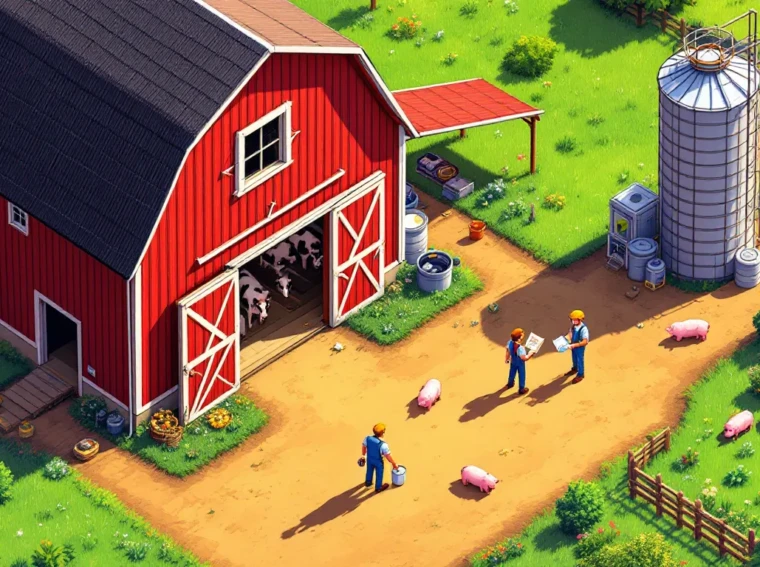
Building a barn in Stardew Valley isn’t just about throwing up four walls and calling it a day. It’s the gateway to a livestock empire that can turn your humble farm into a passive income machine, assuming you don’t mess up the fundamentals. Whether you’re eyeing steady milk profits from cows or banking on truffle-hunting pigs in the late game, understanding barn mechanics from construction costs to animal optimization makes the difference between scraping by and rolling in gold.
This guide breaks down everything: what you’ll pay for each barn tier, which animals actually pull their weight, and how to avoid the rookie mistakes that tank your profitability. No fluff, just the specifics you need to run a barn that works.
Key Takeaways
- A Stardew Valley barn requires 350 Wood, 150 Stone, and 6,000 gold to build, taking three days and occupying a 7×4 tile footprint on your farm.
- Upgrade from the standard barn to the Big Barn (8 animals, 12,000g) for goats and sheep, then to the Deluxe Barn (12 animals, 25,000g) to unlock pigs and auto-feeding for maximum profitability.
- Pigs are the most profitable barn animal, producing truffles worth 625–1,250g each, with a single Deluxe Barn generating 100,000g+ per season when paired with Artisan and Gatherer professions.
- Process raw products into artisan goods using Cheese Presses, Looms, and Oil Makers to roughly double your profit, turning milk into cheese and truffles into Truffle Oil worth 1,491g with the Artisan profession.
- Manage daily barn tasks efficiently by petting animals for +15 Friendship, maintaining grass for free grazing, stockpiling Hay in silos, and installing a Winter Heater (2,000g) to keep animals happy and producing high-quality goods.
- Avoid costly mistakes like buying too many animals before building silos, neglecting daily petting (which causes -20 Friendship loss), leaving barn doors open overnight, and ignoring artisan processing for raw products.
What Is a Barn in Stardew Valley?
A barn is one of two livestock buildings available in Stardew Valley, designed specifically to house larger farm animals. Unlike the coop (which handles chickens, ducks, and rabbits), barns support cows, goats, sheep, pigs, and ostriches, all of which produce valuable goods ranging from milk and wool to the game’s most lucrative item, truffles.
Barns come in three upgrade tiers: the standard barn, big barn, and deluxe barn. Each tier increases capacity, unlocks new animal types, and adds quality-of-life features like auto-feeders. You’ll construct your first barn through Robin at the Carpenter’s Shop in the Mountain area, then upgrade it through the same menu as your farm expands.
The barn functions as both a shelter and production facility. Animals need to be kept happy and well-fed to produce quality goods, which means daily maintenance isn’t optional if you want consistent output. Think of it as a resource converter: you invest in hay and attention, and the barn outputs sellable products or artisan good ingredients.
How to Unlock and Build Your First Barn
Barns don’t have a prerequisite quest or skill level, they’re available from day one, assuming you’ve got the resources. Head to the Carpenter’s Shop (north of Pelican Town, past the community center) and talk to Robin. Select “Construct Farm Buildings” from her menu, and you’ll see the barn option listed.
Materials and Resources Required
The Stardew Valley barn cost for the base tier is straightforward but not trivial for early game:
- 350 Wood: About one full season of tree-chopping if you’re starting from scratch. Clear your farm and hit the forest south of your property.
- 150 Stone: Mining floors 1–40 in the mines or breaking rocks around your farm. Easy to stockpile passively.
- 6,000g: The real gate. You’ll need a few successful crop harvests or some lucky fishing hauls.
How much is a barn in Stardew Valley, really? 6,000 gold is roughly two full Cauliflower harvests in Spring (if you planted a decent plot) or one good Ancient Fruit run. It’s a mid-Spring to early Summer goal for most playthroughs.
What do you need for a barn in Stardew Valley beyond materials? Enough cleared space on your farm. Barns occupy a 7×4 tile footprint, so scout your layout before committing.
Construction Time and Placement Tips
Robin takes three days to complete construction once you’ve paid and chosen a location. You can’t cancel or move the barn during this window, so plan carefully.
Placement tips:
- Near grass patches: Animals graze outside during sunny days (if you open the barn door). Placing your barn adjacent to a large grass area cuts hay costs significantly. Many players choose the Rancher profession early to boost livestock efficiency.
- Accessible pathing: Leave room for you to navigate quickly. Barns generate daily tasks (feeding, petting, milking), and bad pathing wastes real-world time.
- Away from crop fields: Animals don’t destroy crops, but you’ll want clear zones for planting vs. livestock to keep your farm organized as you scale.
Some players cluster barns near silos for thematic reasons, but functionality beats aesthetics here.
Barn Upgrade Tiers: From Basic to Deluxe
Upgrading your barn unlocks capacity, animal variety, and automation features. Each tier is a standalone purchase, you can’t skip from standard to deluxe. You’ll always upgrade the same structure: Robin modifies the existing building.
Big Barn: Unlocking More Space and Animals
The big barn Stardew Valley upgrade doubles your capacity and opens up additional animal types.
Big Barn cost:
- 12,000g
- 450 Wood
- 200 Stone
- 3 days construction time
What changes:
- Capacity increases from 4 animals to 8 animals.
- Unlocks goats and sheep for purchase at Marnie’s Ranch.
- Adds a Pregnancy system for barn animals (if you’ve unlocked it via the Deluxe Coop).
The Stardew Valley big barn is the sweet spot for mid-game players. Eight animals generate enough product to justify artisan good processing (cheese presses, looms), and sheep wool becomes a legitimate income stream once you have a few Rabbits’ Feet saved up.
Goats produce goat milk every other day (compared to cows’ daily milk), but Goat Cheese sells for more than Cheese. It’s a trade-off between consistency and per-unit value.
Deluxe Barn: Automation and Maximum Capacity
The deluxe barn Stardew Valley upgrade is the endgame standard. It’s expensive, but the auto-feeder alone justifies the cost if you’re running multiple barns.
Deluxe Barn cost:
- 25,000g
- 550 Wood
- 300 Stone
- 3 days construction
What changes:
- Capacity maxes out at 12 animals.
- Unlocks pigs, the single most profitable barn animal.
- Adds an Auto-Feed System: If you have hay in your silos, animals are fed automatically each morning. No more manual hay placement.
The Stardew Valley deluxe barn is mandatory if you’re serious about truffle farming. Pigs require deluxe barns and produce truffles outdoors during Spring, Summer, and Fall, worth 625–1,250g each depending on quality and whether you’ve chosen certain professions.
The auto-feeder is underrated. It saves roughly 30 seconds per barn per day, which adds up when you’re managing a farm with multiple buildings. Some veteran players on modding communities like Nexus Mods have even tweaked barn mechanics, but the vanilla deluxe barn is already efficient enough for most playstyles.
Which Animals Can Live in Your Barn?
Not all barn animals are created equal. Each has distinct production cycles, profit margins, and unlock requirements. Here’s the breakdown.
Cows: Milk Production and Profitability
Cows are the default barn animal and the backbone of early livestock income.
- Cost: 1,500g at Marnie’s Ranch (standard), 2,500g (Brown variation, same stats).
- Production: One Milk per day once they mature (5 days after purchase). Large Milk unlocks at high friendship.
- Base Milk value: 125g. Cheese (using a Cheese Press) sells for 230g, nearly doubling profit.
- Daily upkeep: 1 Hay (or free grazing).
Cows are reliable. They produce every single day, making them ideal for players who want consistent cash flow. Large Milk (190g base, 345g as cheese) starts appearing once your cow hits roughly 200 friendship points, achieved through daily petting and feeding.
Profitability:
- A single cow generates about 6,900g profit per season (assuming daily Large Milk → Cheese).
- Break-even point is roughly 10 days after purchase if you’re processing milk into cheese.
Goats, Sheep, and Pigs: Specialized Products
Goats unlock at the Big Barn tier.
- Cost: 4,000g.
- Production: Goat Milk every 2 days. Large Goat Milk at high friendship.
- Goat Cheese: 400g (Large), compared to regular Cheese at 345g.
Goats are slightly less consistent than cows, but Goat Cheese commands a premium. If you’re running an artisan goods setup and have the processing capacity, goats edge out cows in per-unit value.
Sheep also unlock at Big Barn.
- Cost: 8,000g.
- Production: Wool every 3 days. Can be sheared with Shears (purchased from Marnie for 1,000g).
- Cloth (processed via Loom): 470g.
Sheep are less profitable than pigs but useful for specific bundle completions and mid-game cloth production. They’re a stepping stone, not a primary moneymaker.
Pigs are Deluxe Barn exclusives and the gold standard for late-game profit.
- Cost: 16,000g.
- Production: Truffles (foraged outdoors during Spring, Summer, Fall). Frequency increases with friendship.
- Truffle base value: 625g. With the Gatherer profession, there’s a chance to find two truffles per dig.
- Truffle Oil (via Oil Maker): 1,065g.
Pigs are the most expensive animal upfront and require outdoor access to function, but they print money. A high-friendship pig can produce a truffle almost daily in good weather. Multiply that by a full deluxe barn (12 pigs), and you’re looking at 12,000g+ per day in peak season.
Ostriches: The Unique Barn Animal
Ostriches were added in the 1.5 update and require a Ginger Island unlock.
- How to get: Hatch an Ostrich Egg (found in chests on Ginger Island) in an upgraded barn.
- Production: Ostrich Eggs every 7 days (worth 600g base, 1,200g as Mayo).
Ostriches are novelty animals. They’re not efficient compared to pigs or even cows, but completionists will want one. Guides on sites like Twinfinite detail Ginger Island mechanics if you’re rushing the late-game content.
Daily Barn Management and Animal Care
Running a barn isn’t passive. Animals need daily attention to maintain productivity and produce high-quality goods.
Feeding Your Animals: Hay vs. Grass
Animals eat one Hay per day if kept indoors or if there’s no grass available outside.
Hay sources:
- Purchase from Marnie: 50g per Hay (not scalable).
- Harvest grass with a Scythe: Requires a Silo to auto-store Hay. Each grass tuft has a chance to yield Hay.
- Golden Scythe: Increases Hay drop chance (unlocked by reaching floor 100 in the Quarry Mine).
If you open the barn door on sunny days and have grass outside, animals will graze for free. This is the most cost-efficient feeding method but requires grass management, animals consume grass faster than it regrows without Grass Starters (100g each from Pierre).
Pro tip: Fence off a grass section your animals can’t reach, then harvest it manually with a scythe. This creates a Hay reserve without buying from Marnie.
In Winter, outdoor grazing isn’t possible. You’ll burn through Hay, so stockpile during Spring, Summer, and Fall.
Building Friendship and Happiness Levels
Each animal has a hidden Friendship stat (0–1000) and a Mood stat (0–255). Both affect product quality and production frequency.
Friendship increases via:
- Petting daily: +15 Friendship.
- Feeding: +15 if the animal eats (Hay or grass).
- Milking/Shearing on time: Small bonus.
Friendship decreases if:
- Not petted: –5 to –10 per day.
- Not fed: –20.
- Left outside overnight: –20.
High friendship unlocks Large Milk, Large Goat Milk, and increases truffle spawn rates for pigs. It’s not optional if you want max profit.
Mood is affected by:
- Eating fresh grass (vs. Hay): Major mood boost.
- Being petted.
- Weather: Animals are happier on sunny days.
- Heater (purchased from Marnie, 2,000g): Prevents mood loss in Winter.
Happy animals produce higher-quality goods (Silver, Gold, Iridium stars). Iridium-quality Large Milk sells for 380g base, 552g as Cheese. That’s nearly double the base product value.
Maximizing Profit from Your Barn
Raw animal products are fine, but artisan goods are where barns become profit engines.
Artisan Goods: Turning Products into Gold
Processing barn products roughly doubles their value. You’ll need the following machines:
Cheese Press (Farming Level 6):
- Milk → Cheese (230g, 3 hours)
- Goat Milk → Goat Cheese (400g, 3 hours)
Loom (Farming Level 7):
- Wool → Cloth (470g, 4 hours)
Oil Maker (Farming Level 8):
- Truffle → Truffle Oil (1,065g, 6 hours)
Mayonnaise Machine (Farming Level 2):
- Ostrich Egg → Mayonnaise (1,200g, 3 hours)
The Artisan profession (Farming Level 10, Tiller path) increases artisan good sell prices by 40%. Truffle Oil jumps to 1,491g with Artisan, absurdly profitable. Even cheese becomes 322g per unit, turning a barn of cows into a 10,000g+ per week operation.
Without Artisan, you’re leaving thousands of gold on the table. It’s the single most impactful profession for barn-focused farms. Detailed profession comparisons are available on guides like Game8, which covers meta strategies for various playstyles.
Best Animals for Early, Mid, and Late Game
Early Game (Year 1, Spring–Summer):
- Cows only. You won’t have the capital or processing capacity for anything else. Focus on 2–4 cows, build Cheese Presses, and reinvest profits.
Mid Game (Year 1 Fall – Year 2):
- Upgrade to Big Barn. Add goats for Goat Cheese variety and sheep if you’re targeting specific bundles or want Cloth production.
- Scale to 6–8 animals total across one or two barns.
Late Game (Year 2+):
- Full Deluxe Barns stocked with pigs. Truffle farming is the endgame meta for barn income.
- One barn of 12 pigs generates 100,000g+ per season (Spring, Summer, Fall combined) with Artisan + Gatherer professions.
- Keep a few cows or goats for daily cheese if you want consistent income between truffle hauls.
Common Barn Mistakes to Avoid
Barns punish inefficiency. Here are the pitfalls that tank profitability:
Buying too many animals before you have silos: Hay from Marnie costs 50g per unit. A barn of 12 animals burns 12 Hay per day (600g) in Winter. That’s 16,800g per season just for feed. Build silos early and stockpile Hay during grass-heavy seasons.
Skipping the Heater in Winter: Animals’ mood plummets without a Heater, lowering product quality. A 2,000g investment pays for itself in higher-quality milk and faster friendship gains.
Not petting animals daily: Friendship decay is real. Miss a few days, and your cows stop producing Large Milk. That’s a 65g loss per unit, per day. Multiply by 12 animals, and you’re hemorrhaging profit.
Placing barns too far from your house or main paths: You’ll visit barns every single day. Bad placement adds 10–15 seconds per trip, which compounds into minutes per week. Efficiency matters in Stardew Valley.
Overinvesting in sheep early: Sheep are expensive (8,000g) and produce every 3 days. Cows and goats are better ROI until you’re swimming in gold and just want variety.
Ignoring artisan goods processing: Selling raw milk is a mistake. Cheese Presses are cheap (Wood, Stone, Hardwood, Coal) and double your income. Same for Truffle Oil. If you’re selling raw truffles, you’re playing wrong.
Leaving barn doors open overnight: Animals left outside lose friendship and mood. Close the doors before bed or automate it by simply leaving them inside permanently (they’ll still be happy if well-fed and petted).
Advanced Tips and Tricks for Barn Optimization
Once you’ve got the basics down, these strategies push barn efficiency to the limit.
Auto-Petters (Deluxe Barns only): Obtained from Joja Community Development projects or rare treasure room drops. Auto-Petters handle daily petting automatically, freeing up time. Not essential, but quality-of-life for multi-barn farms.
Grass management with fencing: Place a Lightning Rod or Fence Post on top of a grass tile. Animals can’t eat that specific tuft, and it’ll spread normally. This creates a permanent grass seed that regenerates your grazing area without constant Grass Starter purchases.
Optimized barn layout for pigs: Pigs need outdoor space to find truffles. Surround your Deluxe Barn with cleared dirt tiles (not flooring, flooring blocks truffles). A 12-pig barn with 50+ open tiles around it maximizes daily truffle spawns.
Stacking Cheese Presses inside barns: You can place artisan equipment inside barns. Many players line the walls with Cheese Presses, processing milk on-site. It’s not necessary, but it’s thematically satisfying and saves a few steps.
Profession respec for seasonal profit spikes: The Statue of Uncertainty (Sewer, 10,000g) lets you respec professions. Some min-maxers swap to Gatherer (double forage chance) during truffle season, then back to another profession off-season. Niche, but viable.
Ginger Island barn animals: You can build a barn on Ginger Island (1.5 update). Animals there don’t need Heaters (tropical climate), and you can manage a second livestock operation without traveling. Useful for players who’ve maxed their main farm space.
Modding for quality-of-life: PC players on Nexus Mods have access to barn automation mods (auto-petting, instant processing). Vanilla Stardew is balanced well, but mods like “Automate” turn barns into true idle factories if that’s your style.
Conclusion
Barns in Stardew Valley are deceptively deep. What starts as a simple 6,000g building in Year 1 evolves into a multi-barn operation generating hundreds of thousands of gold by Year 3, if you play it right. The Stardew Valley barn upgrade path from basic to Deluxe isn’t just about capacity: it’s about unlocking the animals and automation that define late-game profit.
Prioritize cows early, scale with goats and sheep in mid-game, and transition to pig-focused Deluxe Barns once you’ve got the capital. Process everything through artisan goods, manage grass and Hay efficiently, and don’t skip daily petting. Do that, and your barn will carry your farm’s economy harder than any crop field ever could.