
Key Highlights
- Start your sim racing journey by defining your goals and setting a realistic budget to guide your purchasing decisions.
- Research essential equipment for your racing sim setup, focusing on a force feedback steering wheel and a sturdy pedal set.
- Consider the compatibility of your gear with either a PC or a console, as this will influence your choice of racing games.
- Evaluate your available space to decide between a full racing cockpit, a wheel stand, or a desk-mounted setup for optimal ergonomics.
- Prioritise build quality and future upgrade options to ensure your investment provides a long-lasting and evolving racing experience.
- Join online communities to get valuable feedback and tips from experienced sim racers and even professional drivers.
Introduction
Welcome to the thrilling world of sim racing! If you’ve ever dreamed of hitting the track in a high-performance race car, you’re in the right place. A sim racing setup uses specialised hardware to create a realistic driving experience, far beyond what a standard controller can offer. This guide will walk you through the essential tips for choosing the right racing simulators and equipment, helping you build a racing setup that delivers an immersive and enjoyable racing experience from your very first lap.
Top Tips for Beginners When Choosing the Right Racing Sims Setup
Getting started with sim racing can seem daunting, but it doesn’t have to be. A racing sim is a combination of hardware and software designed to replicate the physics and feel of real-world motorsport realistically. It works by using a steering wheel with force feedback and a set of pedals to translate your inputs into the racing game, creating an immersive driving simulation.
For newcomers exploring racing sims, understanding where to begin is key. To help you navigate the options, we’ve compiled our top tips for new sim racers. We will cover everything from setting a budget and understanding your goals to choosing the right equipment and ensuring your sim racing setup is comfortable and safe for long sessions.
Define Your Sim Racing Goals & Budget
Before you buy any gear, the best starting point is to ask yourself what you want to achieve with sim racing. Are you looking for casual fun, or do you aspire to compete in serious online leagues? Your answer will shape every decision you make, especially regarding your racing setup and total cost.
Defining your goals helps you decide where to invest your money. A casual player might be happy with a simple setup, while a competitive racer will need more robust and precise equipment. Think about your long-term interests to avoid overspending or buying a setup you’ll quickly outgrow.
Consider these points to help define your path:
- Casual Fun: Enjoying racing games with more immersion.
- Competitive Racing: Aiming to compete against other sim racers online.
- Skill Development: Using simulators to improve real-world driving skills.
- Specific Motorsport: Focusing on a particular discipline like Formula 1, GT racing, or rally.
PC vs Console Compatibility
Your choice between a PC and a gaming console is a fundamental one that affects your entire setup. Both platforms offer excellent racing simulators, but they differ in hardware compatibility, upgrade potential, and the variety of racing games available. Consoles offer a plug-and-play experience, making them a great entry point for beginners.
PCs, on the other hand, provide maximum flexibility. They support the widest range of hardware, from entry-level wheels to professional-grade direct drive systems. Additionally, the PC platform is home to highly specialised simulation titles and a massive modding community that offers endless new cars and tracks.
When choosing hardware, always check its compatibility. Some steering wheels and pedals are designed specifically for certain consoles, while others work on both consoles and PC. Make sure the equipment you choose aligns with your preferred gaming system to avoid any disappointment.
Research Essential Equipment
A proper sim racing setup requires a few key pieces of hardware to deliver an authentic experience. The most important components are a steering wheel and a set of pedals. Unlike a standard gamepad, this equipment provides the physical feedback needed to feel what the car is doing on the virtual track.
When researching a racing wheel, look for a model with force feedback. This technology uses internal motors to simulate the forces you would feel through a real car’s steering, such as the grip of the tyres and bumps in the road. For sim racing pedals, consider a sturdy set that offers progressive resistance, especially on the brake pedal, for better control.
Key equipment to research includes:
- A force feedback steering wheel.
- A set of two or three sim racing pedals.
- A stable way to mount your gear (desk, wheel stand, or cockpit).
- A comfortable seat for longer sessions.
- Your gaming platform (PC or console).
- Your display (monitor, TV, or VR headset).
Consider Space & Ergonomics
The amount of space you have will heavily influence your sim racing setup. Unlike traditional gaming setups that use a desk and chair, a dedicated sim rig is designed to mimic the seating position of a real race car, which requires more floor space. Carefully measure your room before deciding on a setup.
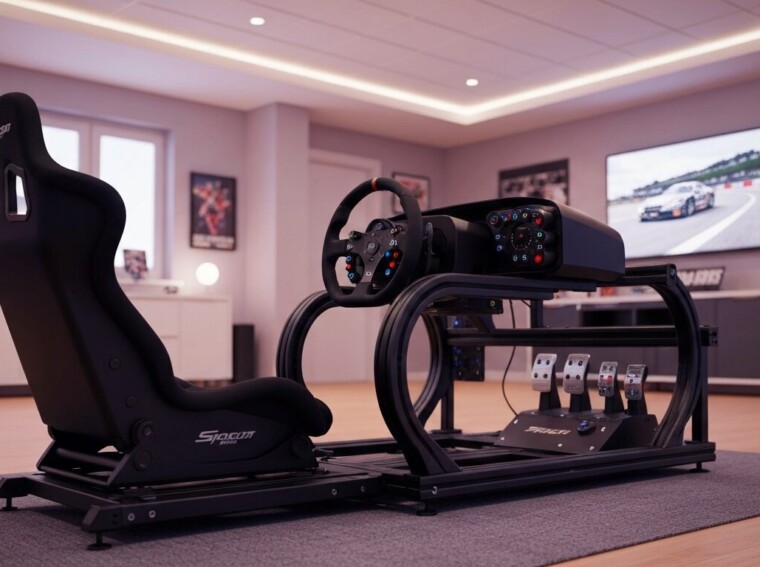
If you are short on space, a foldable wheel stand is a great option. It provides a stable platform for your wheel and pedals and can be easily stored away. For those with a dedicated area, a full racing cockpit offers the ultimate in immersion and stability. These sim rig frames are incredibly sturdy, preventing any flex or movement, even with powerful direct-drive wheels.
Regardless of your choice, prioritise ergonomics. Ensure your seat, wheel, and pedals can be adjusted to create a comfortable and natural driving position. Good posture is key to avoiding fatigue and staying comfortable during long races.
Explore Monitors vs VR
Your display choice has a huge impact on immersion. Most sim racers start with a single monitor or TV, but ultrawide monitors, triple-screen setups, and virtual reality (VR) headsets offer a more realistic driving experience. High frame rates are crucial for a smooth experience on any display, with 90 frames per second (FPS) being a good minimum target.
VR provides unparalleled immersion and depth perception, allowing you to naturally look into corners and judge distances. However, it can be physically demanding and may cause motion sickness for some users. Monitors, especially ultrawide or triple setups, offer a wider field of view and are more comfortable for extended sessions.
Evaluate Build Quality & Upgrade Options
Investing in a setup with good build quality and clear upgrade options will save you money in the long run. A sturdy racing rig made from high-grade materials like aluminium profile will provide a stable, flex-free platform that can handle powerful direct drive wheels if you decide to upgrade later.
For serious sim racers, expandability is key. Look for a racing rig that allows you to easily add accessories like a shifter mount, handbrake mount, or monitor stands. A modular design ensures your setup can grow with your skills and ambitions, allowing you to gradually build your dream rig over time.
When evaluating a racing simulator rig, check for:
- Strong materials like steel or thick aluminium extrusion.
- Adjustability in the seat, wheel deck, and pedal plate.
- Compatibility with a wide range of hardware.
- A clear upgrade path for adding accessories.
Check Reviews & User Feedback
Before making a final decision on your racing setup, it is crucial to research reviews and user feedback. While manufacturer descriptions are helpful, real-world experiences from other sim racers provide invaluable insight into a product’s performance, durability, and value for money.
Look for in-depth reviews on YouTube and read discussions on community forums. This is where you will find honest opinions on both the good and the bad. Pay attention to comments about build quality, ease of assembly, and customer support. This research can help you find excellent budget-friendly options for an entry-level racing sim that still delivers a quality experience.
When reading reviews, consider the following:
- Look for feedback from users with similar goals and budgets.
- Check multiple sources to get a balanced perspective.
- Pay attention to long-term reviews that discuss durability.
- Be wary of overly positive or negative reviews that lack detail.
Join Sim Racing Communities
The sim racing community is one of the most welcoming and helpful in all of gaming. Joining online forums, social media groups, and Discord servers is a fantastic way to accelerate your learning curve. You can ask for advice, share your progress, and find people to race with in online racing leagues.
These communities are a goldmine of information, with experienced sim racers and even professional drivers often sharing their knowledge. You can learn about everything from driving techniques to hardware settings. It is also a great place to ask for recommendations on where to buy equipment, as members often share information about reliable retailers and suppliers in Australia.
Benefits of joining a sim racing community include:
- Getting setup advice from experienced users.
- Learning advanced driving techniques.
- Finding online leagues and events to join.
- Staying updated on the latest games and hardware.
- Receiving troubleshooting help for your gear.
Plan for Maintenance & Longevity
To ensure your sim racing gear performs consistently and lasts for years, a little maintenance goes a long way. Modern racing simulators offer an incredibly realistic driving experience, but this relies on the hardware functioning correctly. Regularly checking and cleaning your equipment is key to its longevity.
Keep your steering wheel base and pedals free of dust and debris. Periodically check that all bolts on your racing rig are tight, as vibrations from force feedback can loosen them over time. If you have advanced racing pedals with a load cell brake, they may require occasional calibration to maintain their accuracy and feel.
Simple maintenance tips for longevity:
- Regularly wipe down your equipment to remove dust.
- Check and tighten all screws and bolts on your cockpit and hardware mounts.
- Follow the manufacturer’s guidelines for any specific maintenance or software updates.
Prioritise Comfort & Safety
When you are deep in a virtual Grand Prix, hours can fly by. That is why prioritising comfort and safety in your setup is essential. An ergonomic driving position not only prevents aches and pains but also improves your consistency and control, just like in the real world.
Choosing the right racing cockpit or seat is vital. Look for a seat that provides good support for your back and can be adjusted to fit your body. Ensure your steering wheel and pedals are positioned so that you can operate them without straining your shoulders, wrists, or legs.
For a comfortable and safe setup, ensure:
- Your seat is supportive and adjustable.
- Your knees have a slight bend when the pedals are fully pressed.
- Your arms are slightly bent when holding the wheel.
- Your monitor is at eye level to avoid neck strain.
- All cables are managed neatly to prevent tripping hazards.
Conclusion
Choosing the right racing sim setup can be a thrilling journey, especially for beginners. By defining your sim racing goals, considering your budget, and researching essential equipment, you’ll be well on your way to an immersive racing experience. Don’t forget the importance of space and ergonomics to ensure maximum comfort during those long racing sessions. Joining sim racing communities can also provide valuable insights and support as you navigate your choices. Remember, the right setup not only enhances your skills but also makes the experience more enjoyable. Take the time to evaluate your options carefully; after all, a well-thought-out racing setup can lead to hours of exhilarating fun on the virtual track. If you have any questions or need assistance, feel free to reach out!
Frequently Asked Questions
What equipment do I need to start sim racing?
To start sim racing, you will need a gaming PC or console, a racing sim game, a steering wheel with force feedback, and a set of racing pedals. You will also need a stable place to mount your gear, such as a desk, wheel stand, or a dedicated racing setup.
How do I choose the best cockpit for my needs?
Choose a racing cockpit based on your available space, budget, and racing goals. A full sim rig offers the most immersive driving experience and stability, but a foldable wheel stand is a great space-saving alternative. Prioritise a model that offers excellent adjustability for comfort and proper ergonomics.
Is sim racing suitable for beginners in Australia?
Absolutely! Sim racing is perfect for beginners in Australia. There is a large and welcoming community, plenty of local suppliers for equipment, and a wide range of racing simulators to suit all skill levels. It is a fantastic way to experience the thrill of online racing and improve your driving.
